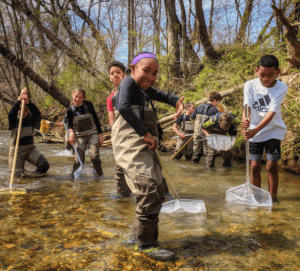
Since 1987, RiverLink has stood as the region’s dedicated nonprofit promoting the environmental and economic vitality of the French Broad River and its watershed. Their mission focuses on improving watershed health and climate resilience, providing permanent public access through conservation easements, reclaiming contaminated lands, empowering more than 1,000 volunteers annually, and educating more than 4,000 students each year about the importance of a healthy watershed.
“Our entire economy and everything we do relates to this river,” said Susan Andrew, the development director at RiverLink.
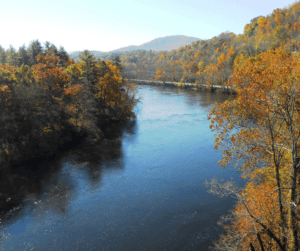
When Hurricane Helene erupted in Western North Carolina, RiverLink’s decades of watershed wisdom proved more valuable than ever. Along a stretch of the French Broad River, Karen Cragnolin Park quietly demonstrated nature’s own resilience strategy — one that the park’s creators had wisely followed.
Karen Cragnolin Park maintained what’s known as the riparian zone — that critical strip of native vegetation along the riverbank that serves as nature’s flood defense system.
“Our paved greenway is set back from the river,” said Lisa Raleigh, the executive director of RiverLink. “When greenways get too close to the river, they don’t have their riparian zone, and then the river undercuts. We have greenways intermittently falling in the river throughout the River Arts District post-storm.”
This principle of working with, rather than against, the river defines RiverLink’s approach. But Helene has amplified their mission dramatically.
“People oftentimes don’t think of rivers being damaged in flooding,” Raleigh said. “But because we’ve compromised our rivers’ banks so much, the rivers themselves have experienced extraordinary — hundreds of millions of dollars — of damage to their banks just from Helene.”
This insight has shaped RiverLink’s post-hurricane response. They’ve created a Recovery, Resilience + Planning Division to ensure the watershed’s 4,000 miles of streams and rivers have a voice in the region’s comeback.
Their approach begins with assessment. RiverLink recently secured a grant to evaluate a six-mile section of the severely impacted Swannanoa River, quantifying the damage and identifying restoration strategies. This work will enable them to access non-disaster relief funding to supplement FEMA support, addressing riverbank damage that might otherwise be overlooked.
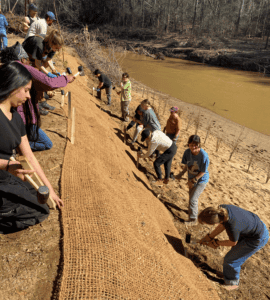
“We’re educating, raising awareness, partnering on all these workshops, and then actually going and doing site visits and bringing volunteers out to do streambank repairs,” Raleigh said.
RiverLink also advocates for more sustainable rebuilding. Rather than simply replacing what was lost, they’re encouraging riverside communities to “go with the flow” by designing flood-resilient parks and infrastructure that work in harmony with rivers.
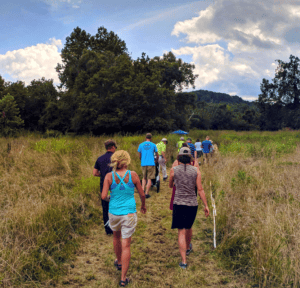
For visitors witnessing Asheville’s recovery, Karen Cragnolin Park offers inspiration. This former car-crushing operation, once contaminated with hydrocarbons, was transformed through phytoremediation, using plants to heal the soil naturally. Today, it features Western North Carolina’s largest public pollinator meadow, with walking paths that connect to the city’s greenway network.
As Asheville rebuilds, RiverLink’s vision offers a promising blueprint — one that respects the power of water while harnessing its beauty and potential.